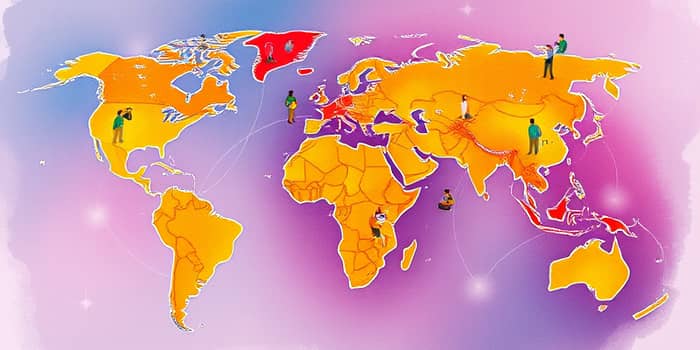
The global economy stands at a pivotal crossroads. While overall growth is slowing, it is far from stagnant. A new chapter is unfolding, driven by the rapid ascent of emerging markets and the transformative power of innovation.
Global GDP growth for 2025 is forecast between 2.3% and 3.2%, reflecting a measured slowdown from the post-pandemic rebound. Yet, emerging markets will outpace developed economies, with growth projections above 4% compared to advanced economies’ modest 1.5% pace.
India leads the charge, with expected growth of 6–7%, while China aims for 3.5–4.5% amid a strategic pivot toward domestic consumption and higher-value industries. Sub-Saharan Africa and the MENA region are also on the rise, leveraging demographic dividends and expanding trade networks.
Brazil demonstrates resilience through deeper ties with Asian partners, insulating itself against some global trade headwinds. Across these regions, a common thread is clear: adopting innovation-driven policies to secure sustainable momentum.
Younger populations in EMs underpin long-term labor supply growth and evolving consumption patterns. This demographic edge stimulates domestic markets and attracts long-term investors seeking dynamic labor forces.
Multinational corporations diversify supply chains post-pandemic, shifting manufacturing and investment toward emerging economies. Strategic reshoring by advanced economies further channels new capital inflows.
Rapid adoption of mobile payments, e-commerce, and digital platforms enables many EMs to bypass legacy infrastructure challenges. India and Southeast Asia have become global tech hubs, while China spearheads AI, automation, and electrification efforts.
Trading among developing nations now accounts for roughly one third of global trade, growing faster than traditional North–South exchanges. Intra-regional commerce, especially in East and Southeast Asia, offers vital buffers against external shocks.
Despite promising prospects, several systemic threats loom large. Heightened trade tensions between the US and China risk fragmenting markets and increasing costs for both producers and consumers. New tariffs and protectionist measures could disrupt export-oriented EMs.
Financial fragility is mounting. Over half of low-income countries face debt distress, with development assistance down by 18% between 2020 and 2023. Capital flight to perceived “safe” markets further strains local currencies and raises borrowing costs.
Policy unpredictability compounds these vulnerabilities. The Economic Policy Uncertainty Index is highest in this century as of early 2025, reflecting volatile financial markets, shifting regulatory environments, and uneven stimulus measures.
Technological transformation is at the heart of EM competitiveness. AI innovations, digital infrastructure rollouts, and mobile-first strategies offer a chance to leapfrog traditional development stages. Investments in data centers, broadband networks, and smart manufacturing are accelerating.
Simultaneously, de-dollarization initiatives and alternative payment systems are gaining traction. Regional blocs like BRICS explore non-USD settlement mechanisms, gradually reshaping the global reserve currency landscape.
Regional cooperation enhances resilience. Regional alliances and South-South cooperation help buffer economies against external shocks, enabling coordinated responses to trade disruptions and financial volatility.
Governments are rebalancing their policy focus toward social infrastructure, sustainable development, and climate action. Stimulus measures have become more targeted, funding innovation and margin-enhancing projects rather than broad fiscal expansions.
Additional highlights include a net $6 billion inflow into EM equity funds in June 2025 and EM equities outpacing the S&P 500 in the first half of the year. Meanwhile, Official Development Assistance has declined from $175 billion in 2020 to $160 billion in 2023.
By strategically embracing innovation, strengthening regional ties, and prioritizing sustainable policies, emerging markets are poised to write the next chapter in the global economic story. Stakeholders—governments, investors, and civil society—must collaborate to navigate risks and seize unprecedented opportunities.
As the balance of growth shifts away from traditional power centers, the dynamism of emerging economies and the momentum of technological advancement will define the contours of prosperity in the decades ahead.
References