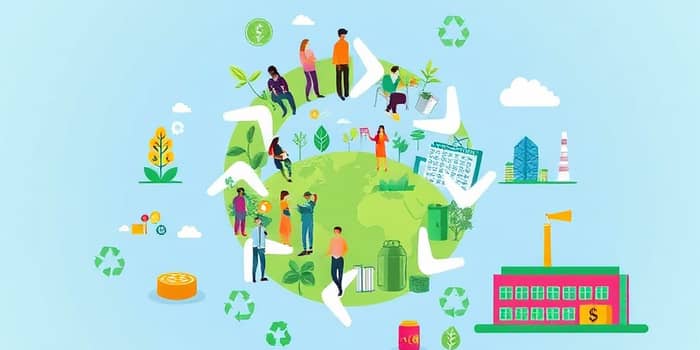
Every day, industries around the world confront the challenge of balancing growth with environmental stewardship. As resources become scarcer and the impact of waste grows more visible, a new financial paradigm emerges to bridge economic ambition with planetary health. Circular Economy Finance offers not just a funding strategy, but a roadmap for building resilient value chains that thrive on reuse, regeneration, and innovation.
By rethinking how money flows into production systems, businesses can unlock pathways that not only preserve natural capital but also drive long-term economic prosperity. This article explores the core principles, financial tools, and real-world successes of Circular Economy Finance, guiding stakeholders toward a future where sustainability and profitability are two sides of the same coin.
At its essence, Circular Economy Finance means the strategic allocation and mobilization of capital to support models that depart from the traditional take-make-dispose approach. It’s about directing loans, equity, and grants toward innovations that keep materials in use longer, regenerate ecosystems, and create distributive value.
Unlike general green finance, this specialized field targets projects explicitly designed to minimize waste, extend product lifecycles, and foster systemic change. From chemical recycling facilities to leasing platforms, the goal is to decouple economic growth from resource consumption and build resilient systems for years to come.
The circular economy rests on three foundational pillars, offering a clear framework for financiers and enterprises alike:
To translate these principles into financial opportunities, additional criteria come into play. Investors look for projects that adhere to design for durability and recyclability, embrace Extended Producer Responsibility, and treat waste streams as valuable resources rather than mere byproducts.
Deploying the right instruments is essential to mobilize capital at scale. Circular Economy Finance employs:
Each tool carries unique risk and return profiles, and when structured effectively, they can drive substantial impact while ensuring financial viability. Blended finance, for instance, can lower the threshold for private investors by absorbing early-stage costs, paving the way for widespread adoption.
When properly financed, circular models yield powerful advantages at every stage of production.
By adopting reuse and remanufacturing strategies, companies can maximize the lifespan of products and significantly cut raw material footprints. In sectors from fashion to electronics, leasing and product-as-a-service approaches transform ownership models, aligning incentives for longevity and repair.
Financial backers also benefit from reduced exposure to raw material price swings, while governments and consumers praise brands that demonstrate reduce greenhouse gas emissions and pollution. As environmental regulations tighten, early movers capture lucrative market segments and forge stakeholder trust.
Leading corporations and agile start-ups alike illustrate the transformative potential of Circular Economy Finance. Philips, for example, pioneered lighting-as-a-service agreements, allowing customers to pay for illumination rather than bulbs. This model incentivizes Philips to supply durable, energy-efficient fixtures and to reclaim materials at end-of-life.
In the textile industry, companies such as Mud Jeans have built entire business models around leasing denim, encouraging customers to return garments for recycling. Chemical recycling ventures are receiving targeted investments that break down plastics into their molecular building blocks, turning waste back into high-quality feedstock. These examples showcase how innovative funding structures can catalyze industry-wide shifts.
Despite its promise, Circular Economy Finance faces hurdles. Standardizing metrics for circularity and impact remains an ongoing endeavor, complicated by diverse industry contexts. Higher upfront capital requirements can deter conservative investors, necessitating robust risk-sharing mechanisms.
Effective stakeholder collaboration is crucial. Businesses, financiers, regulators, and communities must co-create supportive ecosystems, informed by transparent reporting and shared governance. Governments can accelerate progress through incentives, clear regulations, and public investment in infrastructure.
As global pressures intensify, the movement toward circular models grows from a niche concept into an economic imperative. Circular Economy Finance is more than a funding mechanism; it is a catalyst for systemic transformation, aligning prosperity with planetary health.
By embracing paradigm shift in how capital is allocated, stakeholders can unleash waves of innovation, foster resilient supply chains, and ensure future generations inherit a world rich in resources and opportunity. The time to act is now—every investment in circular production brings us closer to a regenerative economy where growth and sustainability advance hand in hand.
References